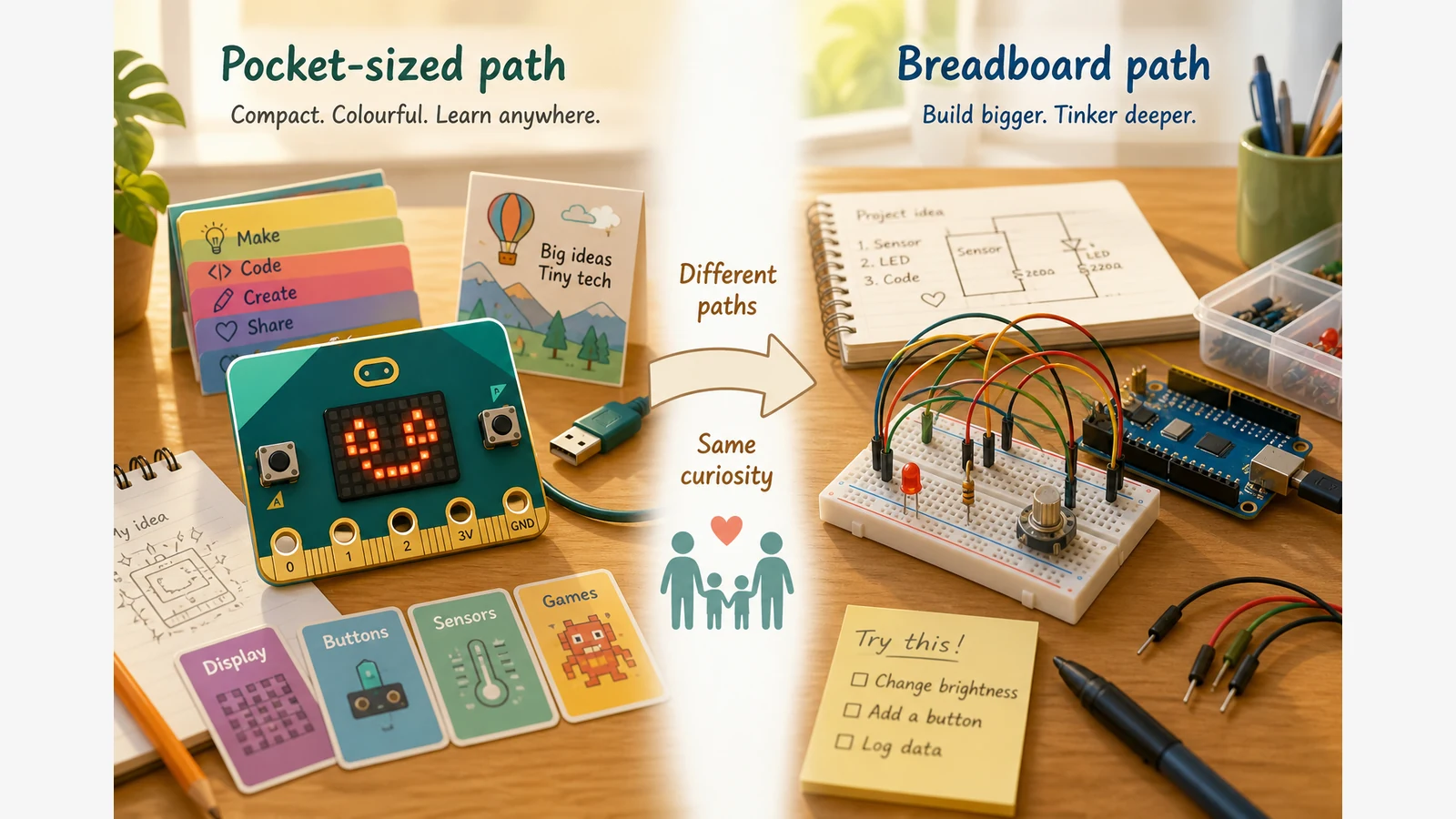
Bbc Microbit Vs Arduino For Kids Uk
For most UK families, BBC micro:bit is the easier start for younger Key Stage classroom-style coding, while Arduino suits deeper electronics once curiosity is proven. Parent-facing UK guides contrast micro:bit’s classroom familiarity with Arduino’s richer breadboard path for older or already-curious learners.
Many state secondaries introduce micro:bit earlier; Arduino-style hardware often appears later when learners want physical I/O beyond a pocket board. Neither path is “required” for GCSE Computer Science—treat this as a family fit decision, not a curriculum mandate.
Side-by-side comparison for parents
| Factor | micro:bit-style path | Arduino starter-kit path |
|---|---|---|
| Setup friction | Usually lower for first screen-and-LED experiments | Higher: IDE, cable, breadboard wiring |
| Coding style | Strong block-based entry, then text options | Text sketches earlier in the journey |
| Electronics depth | Onboard sensors first | External components and circuits from early projects |
| Adult help needed | Often lighter for first sessions | Plan for troubleshooting time |
| Upgrade ceiling | Great for school continuity | Higher headroom for custom gadgets and kits |
Arduino classroom pack materials position structured starter kits as STEM group learning from middle-school ages upward—useful context, not an age guarantee for your child.
Gift decision path
- Has the child already outgrown micro:bit projects and asked for wiring or sensors? Arduino becomes more plausible.
- Is there an adult who can help with IDE install and cable issues for an hour? If not, stay on the lower-friction path first.
- Is this meant as a rainy-day toy with zero troubleshooting? Prefer micro:bit-style kits for now.
- Is the goal GCSE-adjacent computational thinking with physical outputs later this year? Arduino can help as reinforcement—not as a syllabus substitute. See our GCSE Computer Science term plan.
Who should not buy Arduino yet
Families wanting a zero-setup evening activity, or learners who still need block-based confidence before text sketches, should wait. You can still keep Arduino on the horizon and prepare with a breadboard-first, no-soldering kit approach when the time is right.
When you are ready to compare kit contents rather than platforms, use the UK starter-kit contents checklist.